
Replay the game, locate the turning point, ask why it happened, try an alternative and finish with one clear lesson for next time.
1. Replay the game without engine suggestions
Start by remembering what you were thinking. Where did you feel comfortable? When did you lose the thread of the position? Mark two or three moves you were unsure about.
Remember your original plan
Was your goal to develop, attack, defend or simplify? If the next move made the plan harder, write down why. You are studying your decisions, not just reconstructing the moves.
2. Locate the turning points
Now use analysis to identify major changes in the position. A sudden evaluation shift may signal a tactic, positional oversight or an opportunity that was missed.
Not every move that loses a fraction of a pawn needs a deep investigation. Prioritise moves that changed your practical chances.
Not every evaluation change is equally useful
Focus on positions you can realistically learn from: missed tactics, unforced exchanges, unsafe king positions and moves played without considering an opponent’s threat. A small evaluation shift in a complex position may matter less to your training than a clear missed defensive idea.
Why 2.Nf3 matters beyond the move label
Consider the opening position after 1.e4 e5 2.Nf3. White develops a knight from g1 to f3. That single move improves a piece, helps White get ready to castle, and attacks Black’s pawn on e5.
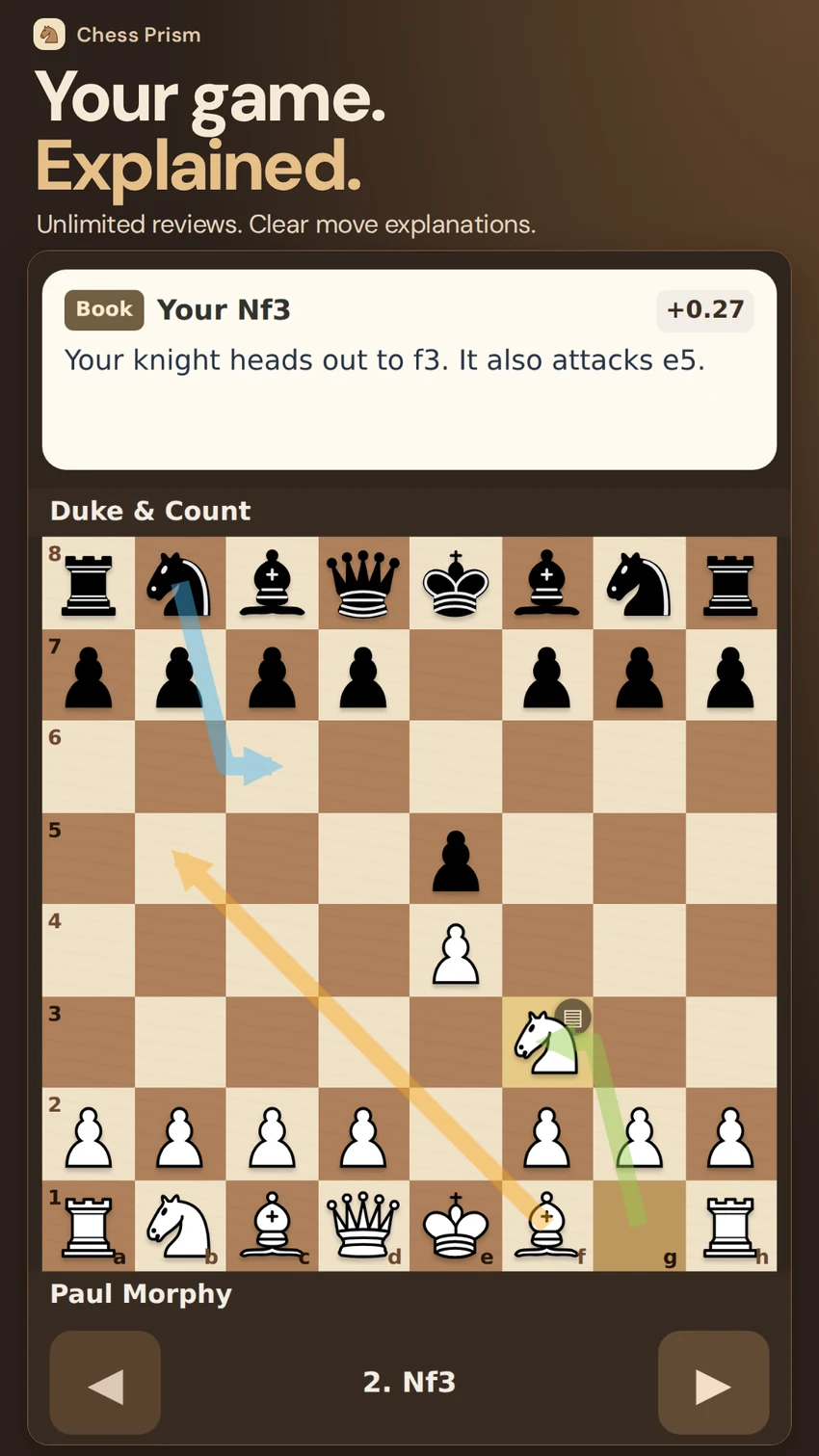
Here, the useful lesson is not a numerical evaluation. It is recognising what the knight now threatens. Black has to consider the e5 pawn and can respond with a developing move such as …Nc6, which defends it. In a real game review, ask whether the opponent's next move dealt with that threat before moving on.
- Identify the piece that moved and its new targets.
- Check the opponent’s strongest reply, including captures and checks.
- State one reason you would choose—or avoid—that move again.
For a larger mistake, use the same approach: understand the threat you missed, then return to the position in Chess Prism’s mistake practice and find the better move yourself.
3. Understand why the move failed
Look one or two replies ahead. Did a defender disappear? Was there a check, capture or threat you overlooked? If the engine suggests an alternative, compare its purpose with your original plan.
Ask the opponent's question
Before accepting a recommended move, imagine how the opponent could respond to your original choice. Checks, captures and threats are a practical starting point. If you cannot explain the difference between two candidate moves, keep investigating the position.
4. Return to the position and try again
Hide the answer and calculate a new move. Give yourself a brief explanation for the candidate: “This move protects the knight and prevents the fork.” Learning a principle matters more than recalling a symbol.
5. End with one specific lesson
Write down one mistake pattern and one habit to change. For example: “Before capturing a pawn, examine the opponent's forcing checks.” Apply that habit to your next few games.
A simple post-game note
What I missed: My opponent could gain time by checking my king.
Next-game reminder: Before launching an attack, check king safety and forcing replies.
This is a learning example, not an evaluation of a particular game. Replace it with what you discovered in your own review.
Where Chess Prism fits into your review
Chess Prism can help with this routine by importing Chess.com, Lichess and PGN games, analysing moves with Stockfish, explaining critical moments and offering mistake practice in an Android app. Reviews are computed on-device, with feature-specific limits and advertising.
Give your next game a better review.
Every thoughtful review is one more opportunity to learn.
Get Chess Prism Free